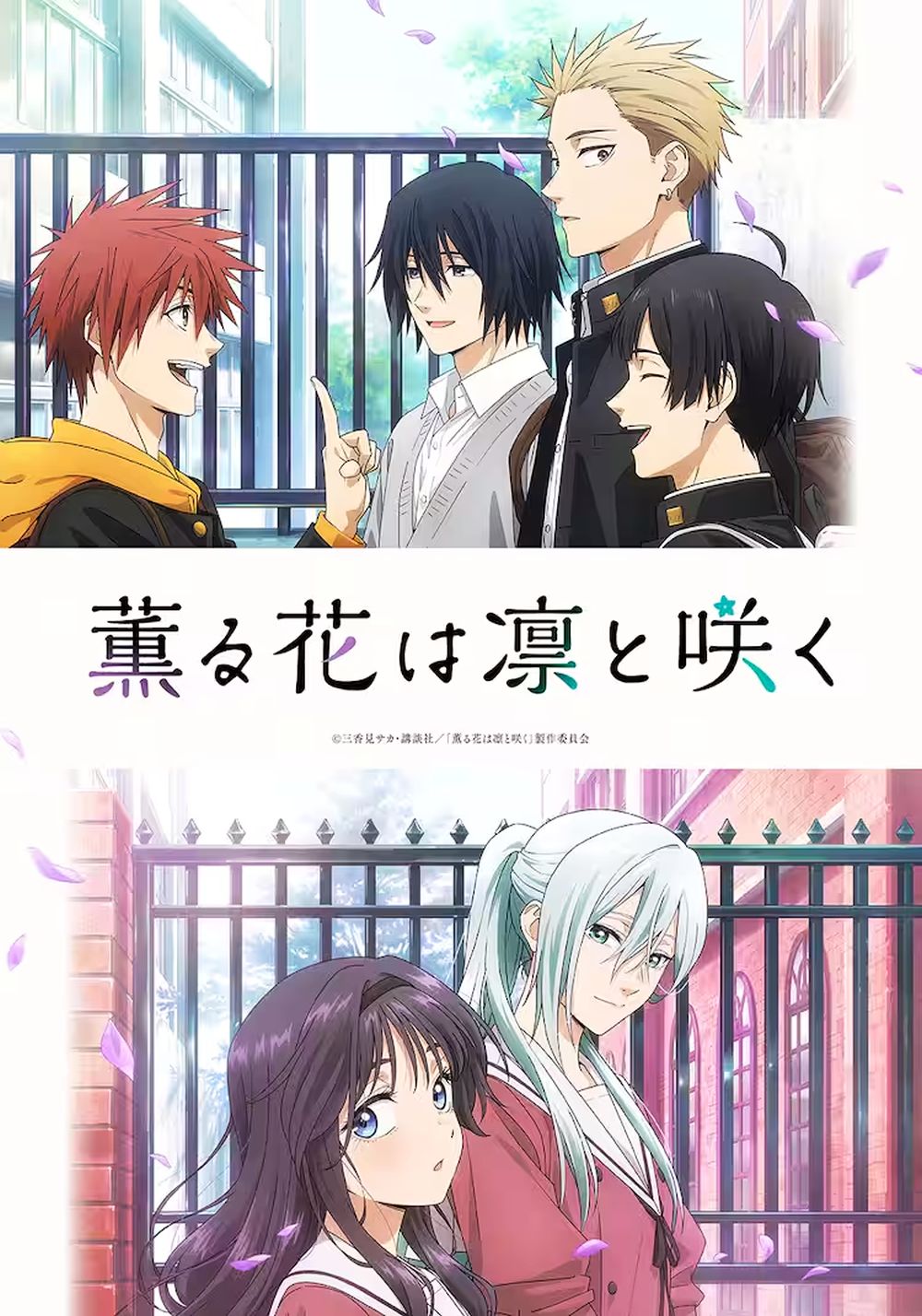
Chidori High School and the neighboring Kikyou are two completely different worlds. The former is a public high school for boys, often boisterous delinquents from poorer families, while the latter is an elite academy for girls from wealthy homes, famous for its pristine image and strict rules. For years, a fierce rivalry combined with deep-seated resentment has persisted between the two schools.
Tsumugi Rintarou is sixteen years old, has an intimidating face, and a reputation as someone best avoided at all costs. This doesn’t bother him—he has a group of loyal friends and feels no need to draw more attention to himself. However, he hides a secret. After school, he helps out at his family’s cafe/pastry shop. One day, he notices a customer who flees in a hurry before he has a chance to speak with her. The very next day, the girl returns and introduces herself as Waguri Kaoruko, announcing that she didn’t run away because of his appearance and that she believes in his kind heart. Although Kaoruko’s radiant personality initially intimidates Rintarou, over time, the boy begins to look forward to every meeting.
Kaoru Hana wa Rin to Saku (2025) – Audiovisual Design
Video
Studio Cloverworks has been proving for years that when they put in the effort, they can create a series that looks virtually perfect from the first seconds to the very last episode. It was no different in this case. The character designs are wonderful, especially those of the fair sex. The main heroine, Kaoruko, looks gorgeous in literally every scene, regardless of her outfit or hairstyle.
Besides, there is essentially no aspect of the visual design that I could find even the slightest fault with. The backgrounds are detailed and pleasing to the eye, while the animation impresses even in seemingly static scenes.
The team responsible for color coordination uses a palette that reflects the emotional state of the characters. Scenes in the pastry shop are bathed in warm, amber tones, suggesting safety and domestic warmth. In contrast, scenes at Kikyou school often utilize cooler, more sterile colors.
The summer festival turned out particularly picturesque. The girls dressed in yukata, flickering colorful lanterns in the background, the flash of fireworks illuminating the night sky, and the warm glow of sparklers in the characters’ hands created an incredible atmosphere of summer break magic.


Audio
The lead heroine is voiced by Inoue Honoka. She has a few lead roles to her credit, but she is not (at least for now) a very recognizable seiyuu. The role of Kaoruko, in my opinion, should open the door for her to appear more frequently as a protagonist, as she performs exceptionally well here. She is the final and most important link that made Kaoruko such a wonderful character. Nakayama Yoshinori in the role of Rintarou, the main character, is essentially a new face in the field of anime. This is his first lead role, and he also definitely managed to perfectly portray a character with a personality that contrasts so strongly with his appearance.
However, the supporting roles are not lacking in popular names, including Hikasa Youko, Inoue Honoka, Yamane Aya, and Uchiyama Kouki. They already have such an established brand that it’s not even necessary to mention that they also performed brilliantly.
The soundtrack composed by Harada Moeki is delicate, based on acoustic instruments, which perfectly corresponds with the sentimental nature of the series, yet at the same time, it is not particularly memorable.
Kaoru Hana wa Rin to Saku (2025) – Plot and Characters
Introduction
When choosing series to watch in the summer of 2025, just one look at the poster told me I would like the show. Watching the PV only confirmed my conviction. I had fairly high expectations for this title, but the first episode already made me realize that they were definitely still too low.
A Brief Overview of the Kaoru Hana wa Rin to Saku Plot
Chidori High School and the neighboring Kikyou are two completely different worlds. The former is a public high school for boys, often boisterous delinquents from poorer families, while the latter is an elite academy for girls from wealthy homes, famous for its pristine image and strict rules. For years, a fierce rivalry combined with deep-seated resentment has persisted between the two schools.


Tsumugi Rintarou is sixteen years old, has an intimidating face, and a reputation as someone best avoided at all costs. This doesn’t bother him—he has a group of loyal friends and feels no need to draw more attention to himself. However, he hides a secret. After school, he helps out at his family’s cafe/pastry shop. One day, he notices a customer who flees in a hurry before he has a chance to speak with her. The very next day, the girl returns and introduces herself as Waguri Kaoruko, announcing that she didn’t run away because of his appearance and that she believes in his kind heart. Although Kaoruko’s radiant personality initially intimidates Rintarou, over time, the boy begins to look forward to every meeting.
What is the series about
The narrative structure of Kaoru Hana wa Rin to Saku is based on the dichotomy of two neighboring worlds which, despite their physical proximity, are separated by a cultural and social chasm. The narrative is conducted in a linear fashion, with a clear division into acts that correspond to the stages of the developing relationship between the main characters and the integration of their peer groups.
At the beginning, Rintarou and Kaoruko live in two different worlds divided by a wall of mutual dislike. The boys from Chidori are pointed at as hooligans and uneducated, while the girls from Kikyou are seen as spoiled princesses. Rintarou tries not to stand out—he knows that his appearance alone inspires fear. When he saves Kaoruko from a harasser on the street one evening and then discovers the girl wears a Kikyou uniform, he panics. He fears that his reputation, weighing over him and his school friends, will bring trouble upon her.
He avoids her like the plague—he even symbolically covers the classroom windows with curtains so as not to see the Kikyou building across the street. To his surprise, however, Kaoruko does not intend to follow the same path. She shows up at the Chidori gate to thank him for his help, defying conventions. Rintarou awkwardly apologizes for his fears, and she, with disarming honesty, announces that she wants to get to know the real Rintarou.
Characters
The characters in Kaoru Hana wa Rin to Saku are characterized by a high degree of psychological complexity, though—fortunately—the creators decided not to overdo it or force them out of standard Japanese character archetypes. There is no point in reinventing the wheel.
Tsumugi Rintarou
He looks intimidating, like a stereotypical yankee (a rebellious street tough), but on the inside, he is the embodiment of gentleness. He wears earrings and dyes his hair blond to give himself confidence, though he is actually a sensitive boy with a heart of gold. Years of struggling with rumors and being judged by appearances have undermined his self-esteem, yet Rintarou possesses extraordinary empathy and emotional intelligence. His passion is confectionery—he helps his parents in the pastry shop with dedication, putting his whole heart into baking cakes. Rintarou’s relationship with his parents—his mother Kyouko and father Keichirou—is crucial. In the safe space of the family pastry shop, Rintarou can cultivate his artistic sensitivity (confectionery), which stands in contradiction to his school image.
Waguri Kaoruko
A heroine who lights up every scene. Although she attends a prestigious school for young ladies from good homes, Kaoruko also has something of an energetic genki girl in her. She is honest, brave, and endowed with inexhaustible positive energy—and she has a comically large appetite for sweets, which adds to her charm. Unlike her classmates from Kikyou, she does not look at people through the prism of stereotypes. She judges with her heart, not by a record or a uniform. She is the one who reaches out to Rintarou first, breaking down the walls between their worlds with a warm smile on her face. The relationship between these two develops slowly. It is based on mutual respect, support, and communication. Kaoruko accepts Rintarou as he is, helping him believe in himself, while Rintarou opens up around Kaoruko and finds the joy of being himself. Their love is the quintessence of pure feelings, devoid of games and falsehood, and therefore incredibly satisfying.
Hoshina Subaru
Initially, she appears as a cold and stern guardian of order—a typical kuudere, hiding her feelings behind a mask of composure. As Kaoruko’s best friend, she feels obligated to protect her from anything that could threaten her future. Prejudiced against the boys from Chidori, she stands in the way of the burgeoning bond between the protagonists. Over time, however, Subaru undergoes an impressive transformation. When she gets to know the true face of Rintarou and his friends, she must verify her views. At first, she reluctantly allows them into her world, only to finally admit that she was wrong.


Supporting Characters
The second pillar of the story is the supporting characters, who do not stay in the shadows for a moment.
Usami Shouhei is a loud class troublemaker and a bakadera (a lovable idiot) who always livens up the atmosphere. He can be hot-headed and has more zeal than sense, but he is loyal to the bone. He would jump into fire for his friends without a second thought. Natsusawa Saku, an intellectual with a sharp tongue, serves as the group’s common sense. He acts the cynic, but deep down, he cares for his loved ones. Yorita Ayato, meanwhile, is a quiet observer, always in the background with an inseparable calm smile. He says little but sees much. He is the first to guess Rintarou’s feelings for Kaoruko, and although he avoids conflict, he can be terrifying when someone truly gets under his skin. All three, starting from a dislike of the Kikyou ladies, mature along with the plot. They learn that the girls there are not just stuck-up princesses. As a result, we get a tight-knit crew of friends whose relationships are a pure pleasure to watch.
It is also worth mentioning Rintarou’s family, as even the parents play a beautiful role here. Rintarou’s mom always supports him and accepts his unconventional choices. His father, a seemingly stern master pastry chef, passes down not only the trade to his hands but also his own values. The family pastry shop becomes a safe haven and a bridge connecting both worlds—it is there that the boys from Chidori and the girls from Kikyou can meet on neutral ground over a piece of cake. It is hard not to appreciate parents depicted so warmly and authentically.

Kaoru Hana wa Rin to Saku (2025) – Evaluation and Summary
Kaoru Hana wa Rin to Saku is a series refined in every detail. From the audiovisual side, it looks beautiful—Studio CloverWorks did a great job breathing life into this subtle story. The whole thing looks clean and is pleasing to the eye, the characters are designed with care, and the backgrounds captivate with a richness of detail. The animation remains fluid in both dynamic scenes and quiet, intimate moments. However, even more impressive is the sincerity with which this story was handled. Kaoruko and Rintarou talk to each other openly, and when a problem arises, they try to solve it immediately. With these types of protagonist personalities, showing this kind of romance is a rather unusual move (they usually rely on misunderstandings). The series leaves a wonderful impression of pure joy and emotion, making it stick in the memory.
I will remember Waguri Kaoruko as one of the most charming heroines not only of the season, but also of the year. Rintarou as a boy who truly deserves his happiness. Kaoru Hana wa Rin to Saku is a story that warms the heart. Such stories remind me why I fell in love with anime and ensure that a warm smile remains on your face long after the screening is over.
Finalny werdykt
Final evaluation

Which translation do I recommend to watch Kaoru Hana wa Rin to Saku (2025)?
- KawaSubs – a very good fan translation. I could nitpick a few things (for example, forcing the Western name order for a completely incomprehensible, unspecified reason), but as a whole, it perfectly captures the dialogue and tone of the series, so I can recommend it with a clear conscience.
Gallery