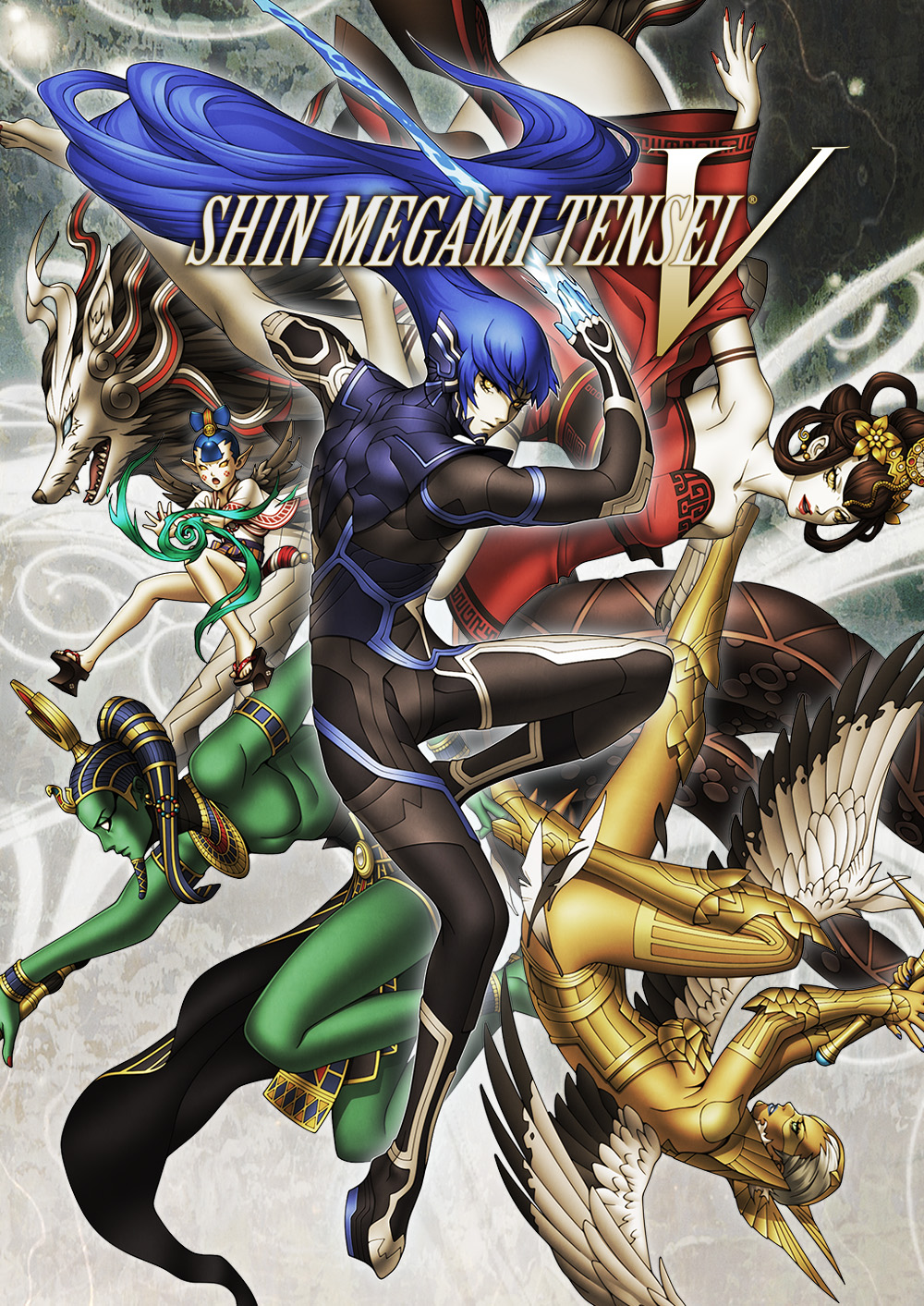
Honda Takumi, an ordinary high school student, and his friends Atsuta Yuzuru and Dazai Ichirou are caught off guard by a mysterious earthquake and transported to Da’at; an alternate apocalyptic version of Tokyo in the midst of a powerful battle between angels and demons. While traveling in this world, he is soon attacked by demons and almost killed, but is saved by a mysterious being called, Aogami. Together they transform into Nahobino, a forbidden being who is neither human nor demon, but rather a half-god.
Introduction
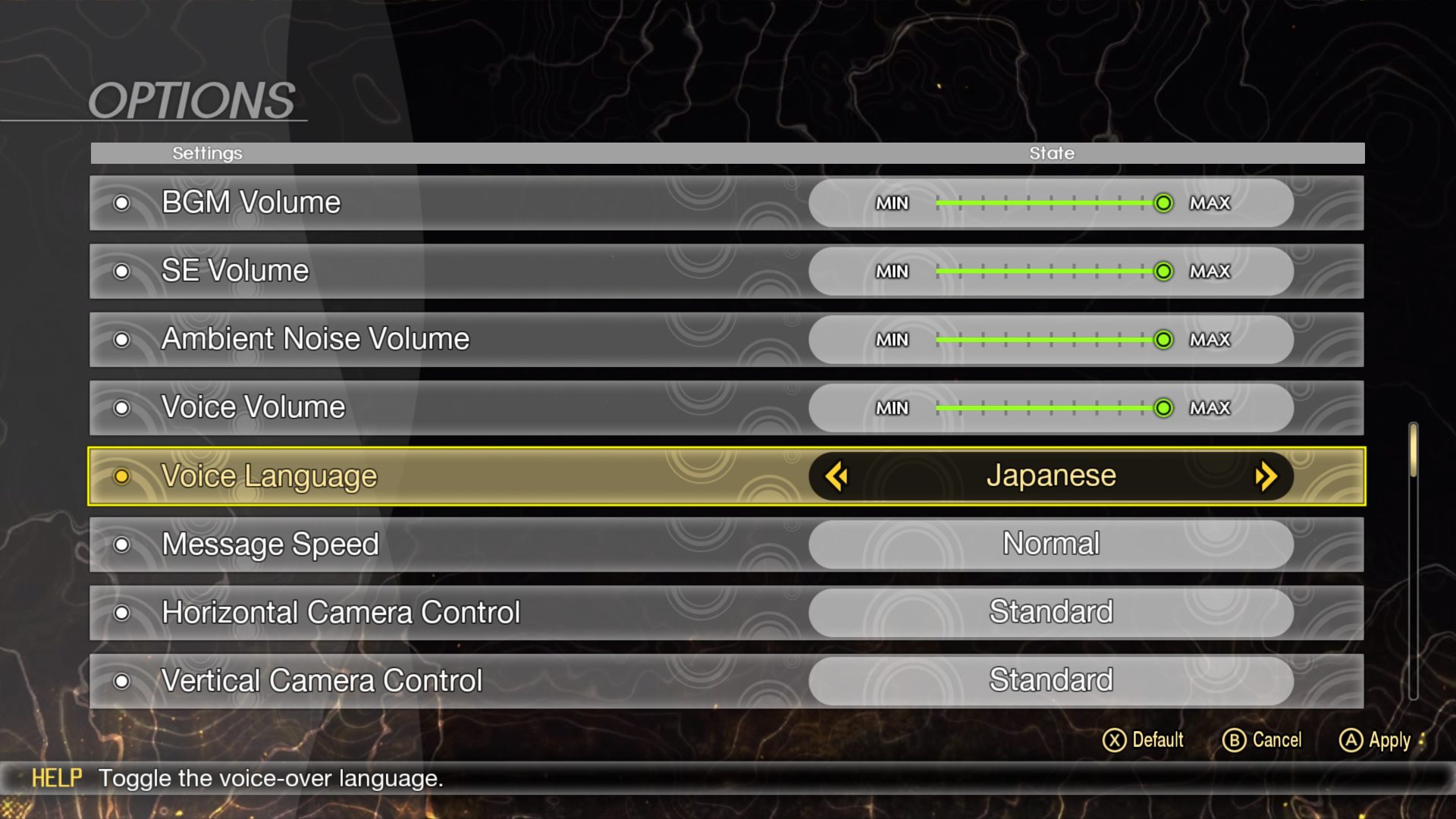
To begin with, I would like to point out that I always use original voices in foreign media. It’s no different in this case either – every time I mention character voices and characters, I’ll mean the original Japanese voice, not the lousy English dubbing, so the first thing I did right after firing up the game was to go into options and change something that should be set by default.
In addition, the description used the name and surname that I gave to the protagonist (I never give my nicknames, and there is no official naming established yet, unlike in the Persona series, where the main character was given an official name and surname due to the anime adaptation).
I didn’t buy the collector’s version because it didn’t have content that satisfied me relative to the price.
Shin Megami Tensei V – Audiovisual design
The game is undoubtedly squeezing the last juices out of the Nintendo Switch. It doesn’t help that it’s based on the Unreal Engine, which translated into performance drops in many places (especially the later stages of the game). However, I can’t complain about how it looks, as the visual quality is really good. The world design itself and the use of colors that fit the atmosphere of the place also deserve praise. Personally, I played the whole thing on the Yuzu emulator, after ripping the ROM from the cartridge – using my console, so I wasn’t affected by performance drops – not only that, I played the whole thing at doubled resolution and 60fps. As for the screenshots – believe me, the game looks much better on a large TV than on the screenshots, even running on the Switch.



As for the sound design, the same praise will also fly from my side. To be honest – at first the soundtrack somehow didn’t hit me. It was only after a few hours of playing that I began to appreciate how it was created and how much the whole thing harmonizes with the presented world, so that by the end of the game I was simply delighted with it. The battle themes, of which the game has quite a few, were also sensational. On the music side, the atmosphere simply pours out of the speakers.
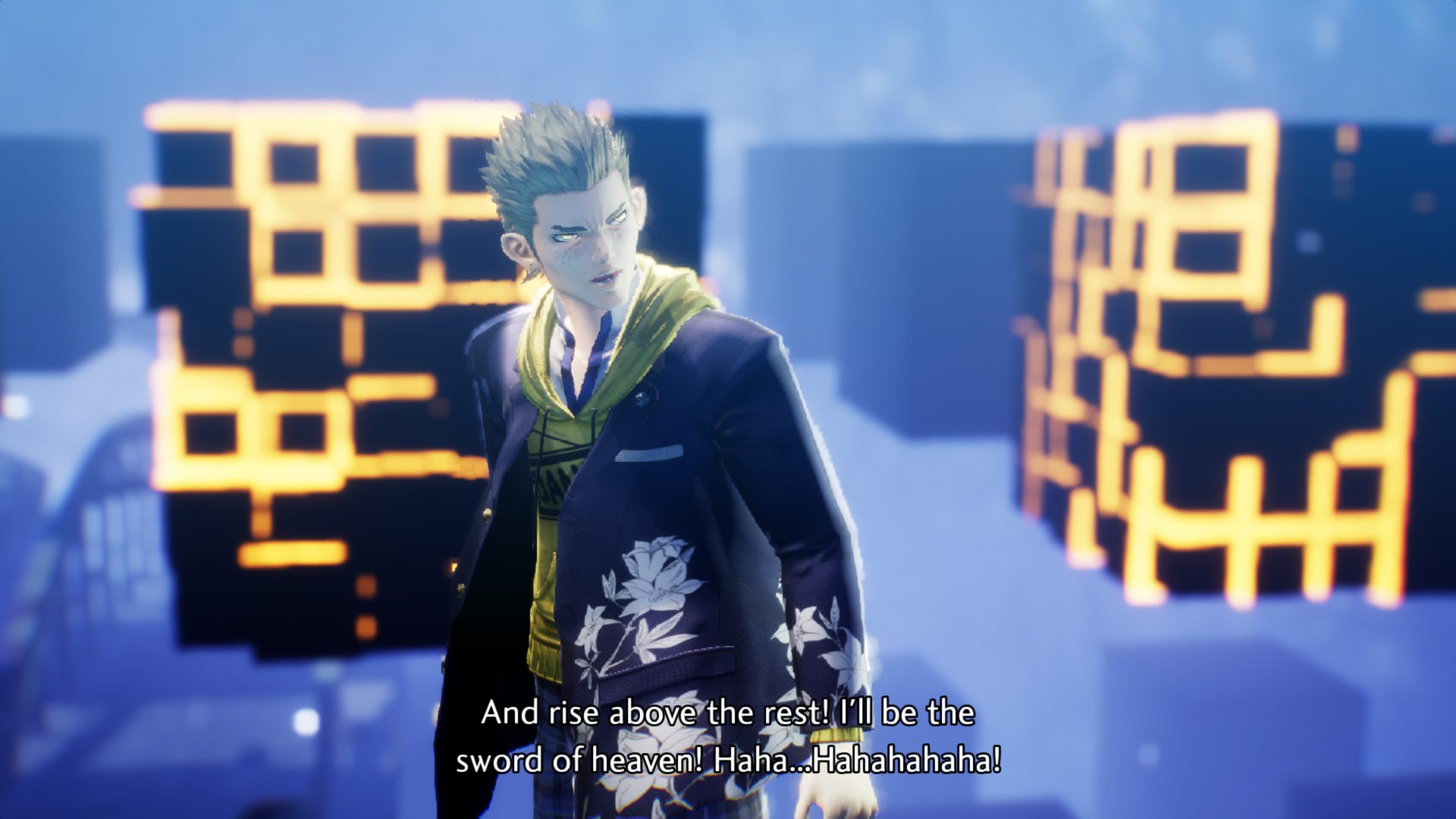
Speaking of Japanese games, of course, one cannot forget about the voice actors. Hayami Saori (one of my favorite seiyuu, as I’ve said many times before in various reviews) in the role of the main character – Isonokami Tao performed (again) perfectly. I could listen to her voice for hours. Although it was my favorite voice in the entire game, the other actors also showed what they were capable of. Toshiyuki Morikawa as Aogami did the job well, accompanying us throughout the adventure. Ishikawa Kaito got the role of Atsuta Yuzuru – the character of a serious student with glasses, which is what comes out best. Taketatsu Ayana in the role of Joka also deserves considerable praise. Of course, I could list the voice actors ad infinitum, as everyone did a sensational job, but I have limited myself to those who particularly impressed me.
Shin Megami Tensei V – Translation
Here, apart from details like the nonsensical reversal of the name order compared to the original, the complete omission of honorifics or the trivialization of the older/younger sibling distinctions which in several places resulted in a considerable change in the overtones of scenes and individual odd decisions – I can hardly complain about anything more, as is usually the case with Japanese games and their official translations.
Shin Megami Tensei V – Plot outline and Characters
Shin Megami Tensei has always been synonymous with darkness and edgy atmospheres. Among other reasons, this is why I incomparably prefer the newer Persona games. Nonetheless, I have the impression that the fifth game, which I review here, let loose quite a bit in this aspect and the whole thing, although still dark and a bit pretentious in places, was much more palatable to me. Another thing – there was never an overabundance of dialogue in the main SMTs, which also caused me to somehow find it difficult to get along with the characters and experience the whole story with them (again – unlike Persona, where I got so absorbed in the story because of the extended dialogue and heavy characterization that when fighting in more serious clashes, I actually felt like I was among them). That hasn’t changed here. We get a few sections in the game where a little bit of conversation occurs, but the conversations rather drive the plot, and the characters are just tools for storytelling. This kind of storytelling doesn’t really appeal to me, as I much prefer when the story is led by the characters – as in most Japanese games and Japanese media in general. However, this doesn’t mean that the plot in SMT V is bad. The further into the game you get, the more interesting it gets, and the ending is already a rough ride with no holds barred in the traditional SMT style. There are also some interesting plot twists along the way.
There are 4 endings to choose from (one of them hidden). The deciding factor is our final choice, where we simply have to decide who we will help. And these are quite extreme options, and believe me – it is difficult to make this choice. Three of the endings are fairly standard branching endings. Shin Megami Tensei V is a bit different from the previous installments: no matter what choices we make throughout the game, there will always be an option to choose which of the three standard endings you want to see.


Shin Megami Tensei V – Gameplay
If one is familiar with the games of this universe, one will certainly feel at home right away. Even if they were only Persons. SMT again puts the main emphasis on combinations when fusing demons and creating the best possible skillsets. This is the core of the entire gameplay.
We start the game at Jouin High School located in Shinagawa – one of the districts of Tokyo. After a brief introduction, there is an opportunity to explore and talk to students. Exploration in third-person mode, however, is strictly limited to just a few locations. The largest of these is the building of the school just mentioned.


On the other hand, on the streets of Tokyo, we move around with a standard cursor designed to indicate where we are at the moment.


However, this mode of exploration only applies to the living world, i.e. Tokyo in real life. 90% of the game’s action takes place in a hell-like place (the original term is 魔界/makai – that is, the world of demons, in translation it is referred to as netherworld). There we have to deal with semi-open, rather sizable locations, which we already traverse in a normal third-person view with a full game interface. This is where we accept side missions from friendly demons, where we search for all kinds of loot, and where we carry out battles while gaining valuable experience points.


Here is probably the biggest change compared to previous parts. We move around in really well-designed and well-thought-out worlds full of various simple puzzles and obstacles that we have to bypass to reach our destination. There are no more random battles (excluding traps) or randomly generated boring dungeons. The team really made an effort to add variety to our gameplay, and for me personally, it was really a breath of fresh air. It should be remembered that there is still (fortunately) no autosave function, so dying after a long time collecting experience points without saving often hurt a lot. It also forces the player to constantly analyze – whether to snag a few more demons, or maybe go back to the save point already to heal the hero and his demons while losing some time to get back to the point where we were before.
So what will really interest us most of all? Well, the creators have made the save points into a kind of hub, where you can take care of almost everything you need most. From saving to healing. Already at the very beginning we unlock the option Cadaver’s Hollow, where a demon named Gustave offers his assortment. At his place we can also sell things we found on our escapades called relics (these are T-shirts, anime merch, game consoles, etc.). In addition, Gustave offers us rewards for finding Miman mini-demons. These are hidden in almost every location in considerable quantities. For every five Mimans found, Gustave offers us rewards. The more important thing we get for finding them is glory points, which are a key element of our character growth ( but more on that in a moment).


After some time, we will also see the World of Shadows option, where we will be able to perform demon fusion and slowly fill up the entire compendium. This activity requires a lot of explanation, especially for someone who has never dealt with MegaTen games. I will only briefly write that it is not unimportant which demons we combine with each other. The one formed from the fusion of two others can inherit the abilities of the previous ones, so careful selection of ‘parents’ has great importance and is actually key to creating truly powerful allies.


Demon fusions are not the only option available in this submenu. On the map, we can find demon essences (at different experience levels) in various places, which we can use to teach our main character (as well as other demons in our inventory) new attacks or passive skills.
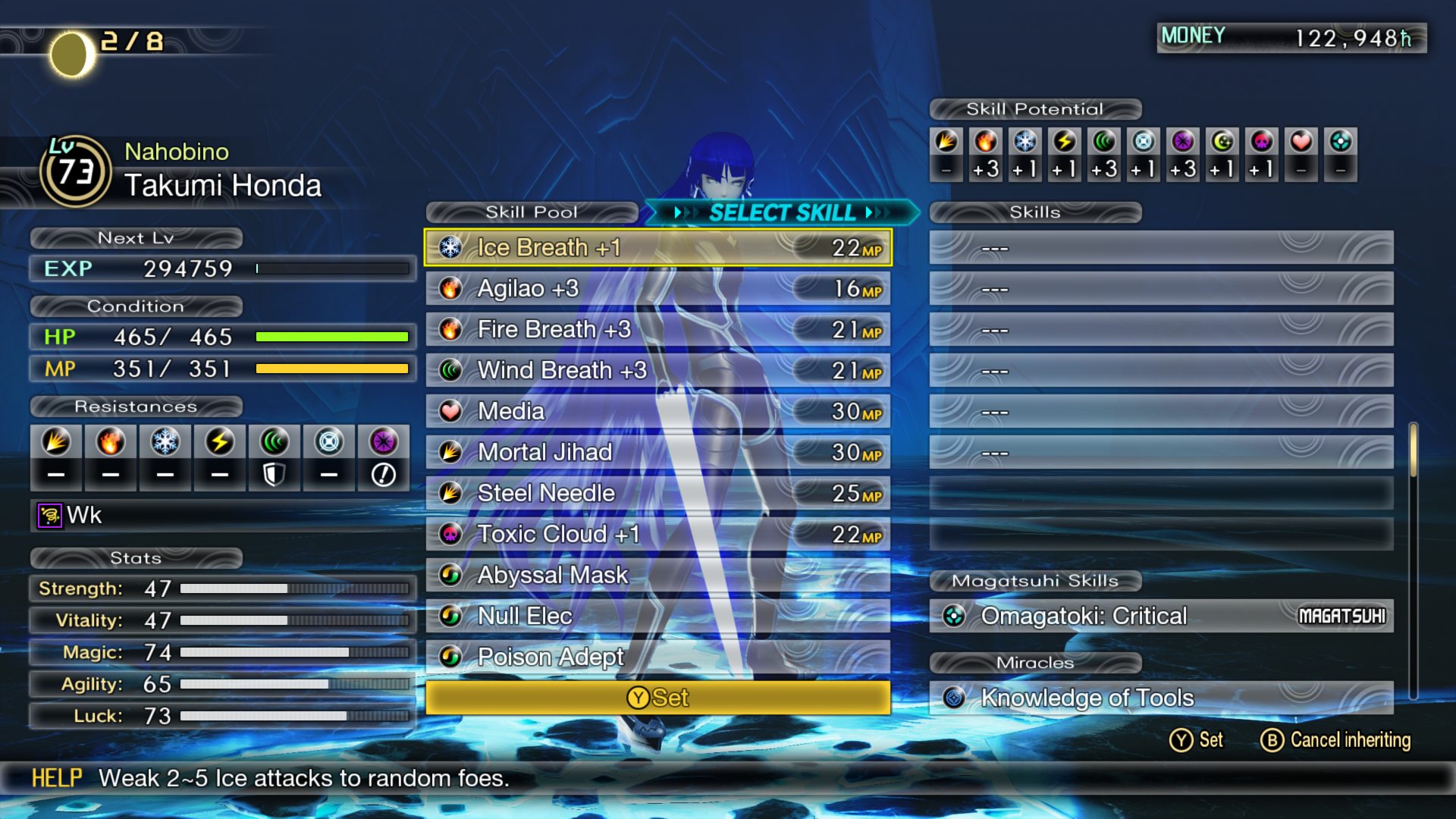
The last important option in World of Shadows are Miracles. This is where we use the glory points received for finding Miman (these points can also be earned in other ways, but about that a bit below). This is another key mechanic. Here we unlock a host of important features, skills or enhancements to our attacks, enabling us to succeed in clashes with tougher demons. New options unlock after defeating Abscess – that is, a concentration of demons personified in the form of a huge red eye in new areas that cover our map in red.


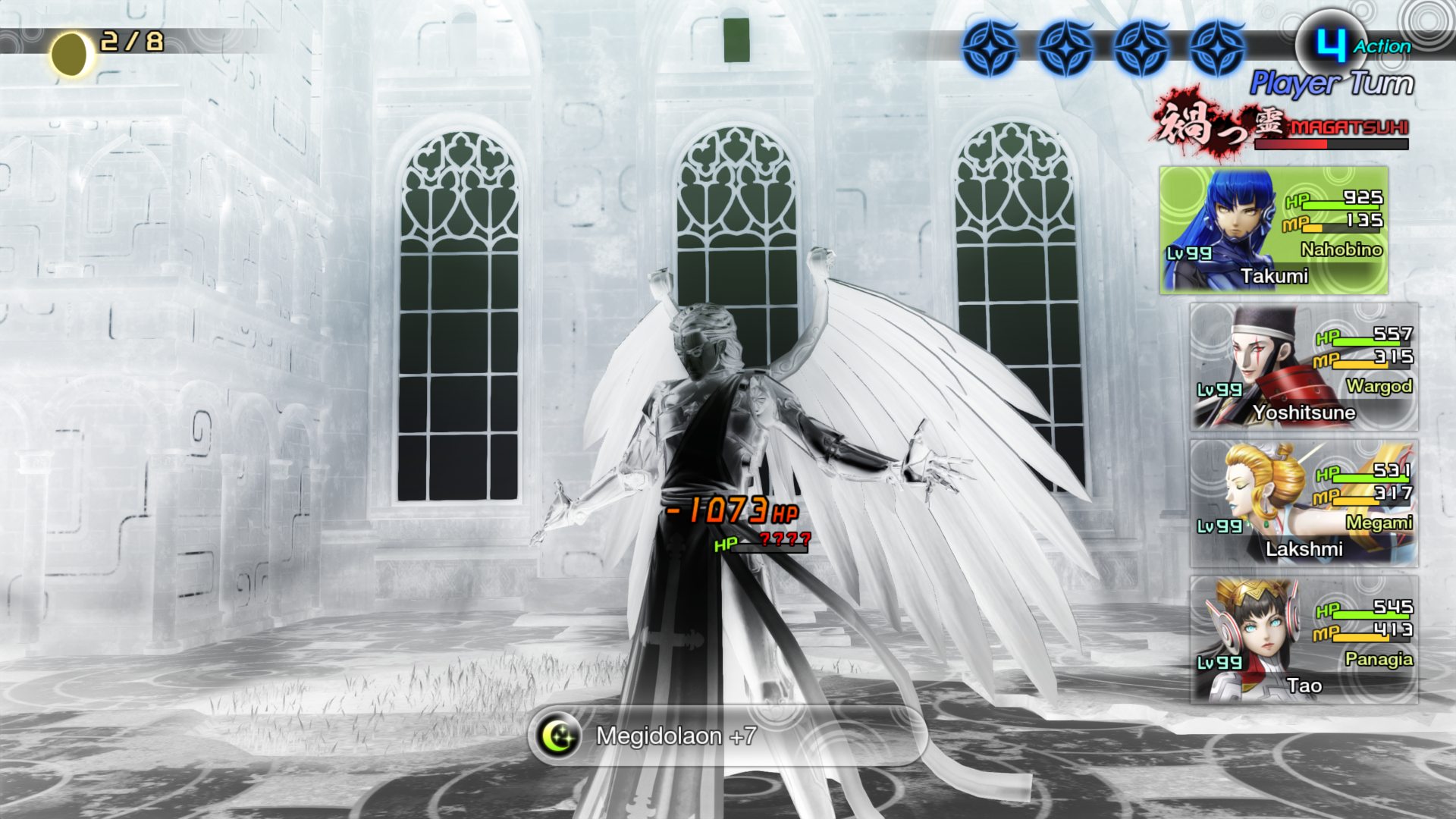
When initiating a fight in the world of demons, we do not immediately proceed to attack. If we were not attacked by surprise, we get an additional phase in which we can peacefully approach the issue and talk to the opponent. Each demon has its own character, so the choice of lines in dialogues has a huge impact on how the whole conversation will turn out and what reaction we will evoke. Most demons can be easily annoyed, which will result in an immediate transition to the opponent’s turn. However, if we make good choices, we have a chance that a particular demon will want to join our team (they often additionally ask for some percentage of our life, magic points or certain items from our inventory or simply money). Interestingly – conversations are also affected by the phase of the moon (visible in the upper left corner of the interface). During a full moon it is easier to recruit new allies. The full moon also affects demon fusions (which can be easily detected even without looking at what phase the moon is currently in – in World of Shadows we hear an altered theme playing in the background).


There are also a lot of tougher enemies roaming around the map, for defeating them, we get a lot more experience points and rare items. They are marked with larger markers, and fights with them are often quite a challenge (as long as our team has a comparable level).


Of course, what I have written above is only a small fraction of what the creators of the game have offered us, but it’s best to find out for yourself. Those of you who are completionists, will have about 80 hours of running around and doing various side missions or collecting hidden items. I rather don’t belong to this group of players – I collect things I need to pass the game without any problems – everything within the limits of common sense, so as not to cause a feeling of burnout.
Finally, I will only mention something that will greatly facilitate the development of characters and our demons. These are the battles with Mitamas. That is, demons in the shape of tears 0 different colors. The problem with them is that they do not appear in large numbers, and their weaknesses change with each fight. The matter is further complicated by the fact that only one type of magic works on them, and every other attack (except, of course, the almighty type) they block. Before a long time I fought blind, then I remembered that there is after all a very cheap way to recognize their weaknesses. It is an item called spyglass (available for purchase for pennies in the Gustave store). Back to the topic of Mitama and their types:
Ara Mitama: These are the Red Mitama and the most common. They drop Grimoire items that raise the demon’s level by one, up to a maximum of the current Nahobino level.
Saki Mitmama: These are Yellow Mitamas, dropping items that can be sold for the currency applicable in the demon world (Makka).
Nigi Mitama: These are Blue Mitama, drop items whose raising gives Nahobino Glory points.
Kushi Mitama: These are brownish/gold Mitama and the rarest in the game. They drop Gospels, which raise Nahobino’s level by one.


Summary and evaluation
I approached SMT V rather cautiously. As I mentioned above, the series does not have my favorite JRPG or general storytelling features. I have not played all possible parts and spinoffs, but the series is familiar to me. The first few hours of the game turned me off and it landed on the pile to be played at a later date. However, I came back to it, finished the first location and the game sucked me into its world for good. So much so that I finished it in a few days, staying up several nights. I managed to finish it in 42 hours. As I’ve already mentioned – I’m not one of those people who do every possible side mission (and there were really a lot of them – some interesting, some fetch/carry), but I never skip the dialogues (this is also due to the fact that I love to enjoy good voice acting, which I’m pretty much always guaranteed to do with Japanese media – using original voices, of course, and not poor dubbing). I have the impression that the game can be completed much faster (also without skipping dialogues) – I probably would have managed around 30 hours if I hadn’t played for at least a few hours with demon fusions and collecting leveling items dropped from creatures called Mitama, which resulted in the fact that around 70% of the game’s progress I already had the main character at the maximum level 99.
My attitude towards this production changed almost 180 degrees from the time I first launched to completion. And not at all because of the theme and what the content of the ending was. It’s just that with each hour I appreciated more and more the world that the developers presented to me. I had the impression that each successive world (the ruins of Tokyo in Hell) was created with even more passion and idea. The gameplay was enjoyable both on the platforming side (there were a lot of smaller or larger puzzles and way-finding by overcoming various moving obstacles) and the combat itself. I approached the grind in this title positively, because the fights were simply enjoyable.
SMT V was not a difficult game for me, especially if you compare it with older entries in the series, which were harsh in terms of difficulty. Here the difficult part was basically only the beginning. Further on, it was enough to think a little and it went quite easily.
I have been thinking about the rating for a long time. At first I thought that I would not complete the game at all and there would be no review. Later, for a long time I was convinced that I would give 7. However, after completing it, it occurred to me that the soundtrack and voice actors must increase the rating by at least half, and the ending itself (although completely not in my climate) by another half. Thus, I decided to give it a 8/10. I believe that this is one of the best games currently available on Switch and a must-have item for any JRPG fan. It doesn’t match up to Xenoblade 2 for sure, but I can easily put it next to Fire Emblem Three Houses, Triangle Strategy or Zelda BoTW when it comes to exclusive titles.
Shin Megami Tensei V – screenshoots: