
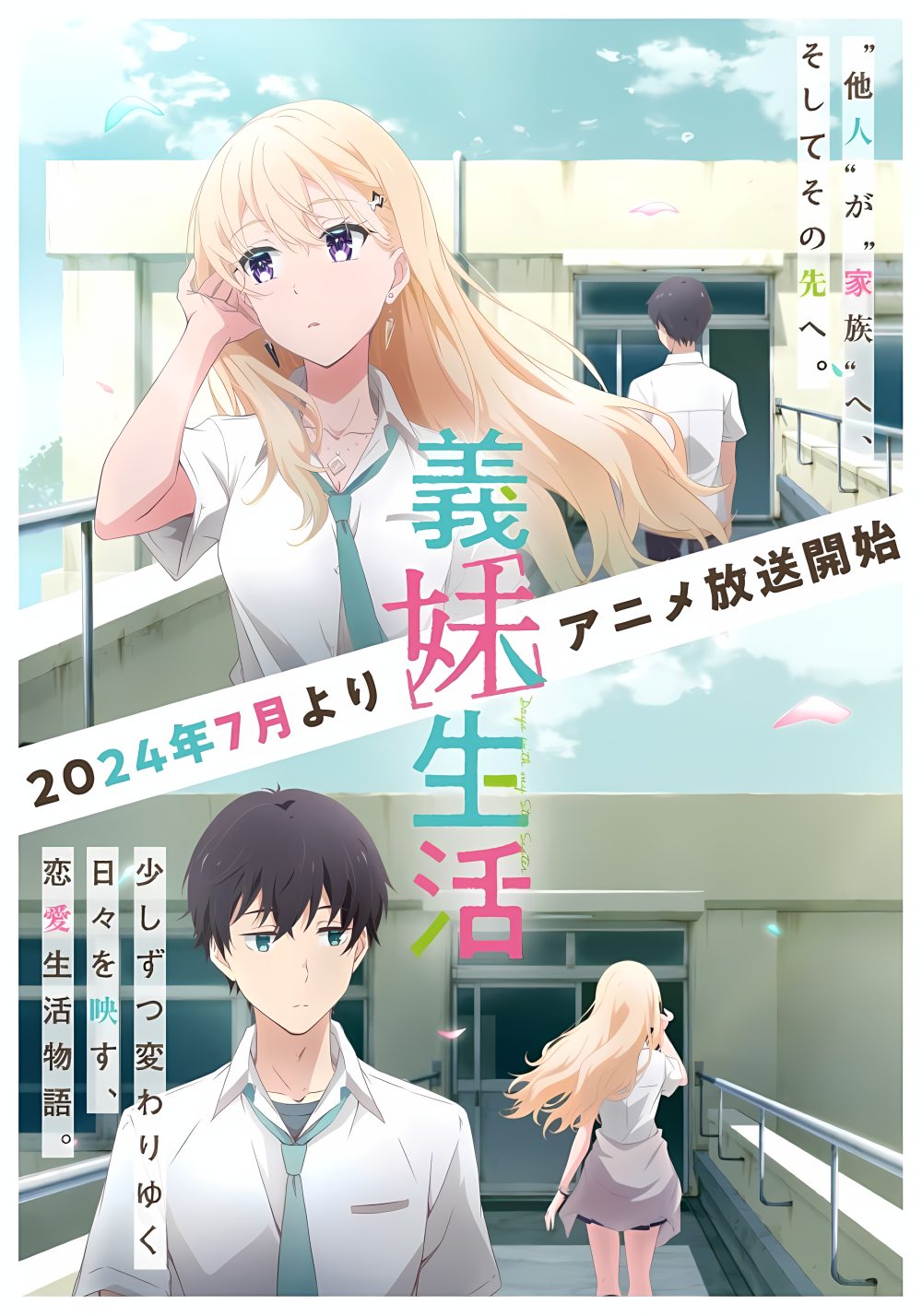
Seventeen-year-old Asamura Yuuta is a talented young boy. He lives alone with his father and often works evenings to save money for his future studies. One day, he learns that he will soon have a stepsister, as his father recently met a woman with whom he feels happy, and they are planning to live together soon. Although Yuuta is understanding, he isn’t quite sure how to approach the subject of having a stepsister.
At a family meeting, Yuuta meets Ayase Saki and her mother. They exchange a few words and quickly find mutual understanding. They promise to maintain a friendly atmosphere while trying not to interfere too much in each other’s daily lives. However, Saki isn’t really sure how to live with other people under the same roof, especially close ones. Due to her mother’s work, she rarely saw her and would often come home from school to an empty house. Her life is about to change drastically. Gradually, she starts to realize that Yuuta is no longer just a stranger she occasionally talks to.
Gimai Seikatsu (2024) – Audiovisual Design
Video
I’ve read a lot of comments in discussions about certain episodes where people complained that Gimai Seikatsu looks bad or has terrible animation. At times, I wondered if we were even watching the same show. Let’s start with the fact that the animators and writers at Studio Deen took a highly artistic approach to depicting reality in their adaptation of the light novel by the same name. Many scenes were presented in rather unusual ways, using various tools of visual storytelling, which blended perfectly with the overall atmosphere of the series.


We see a lot of shots using unconventional angles, especially during moments of high emotional tension or key moments for the main characters. These scenes are often marked by contrasting visuals, sometimes with highly saturated colors, and other times quite the opposite. Meanwhile, the everyday life scenes were shown in a more traditional manner.
I also don’t really get what the complaints about the animation were all about. Not every series needs flashy effects and dynamic frames. Here, the animators focused on a completely different aspect of presentation, and they pulled it off beautifully. As for the details, I couldn’t complain. The character designs were also a delight to look at. The main heroine was simply stunning.
Audio
All of the voice actors performed excellently, as usual. However, I need to focus on Amasaki Kouhei and Nakashima Yuki, the seiyuu who voiced the two main characters (Saki and Yuuta). At first glance—or rather, at first listen—you might think that Saki is your typical reserved and unemotional teenager, while Yuuta seems like the kind-hearted and logical boy next door. This is partly true, but as the episodes progress and we get to know more about their pasts, you truly start to appreciate what both the actors and directors achieved. By the climax in the final episode, I couldn’t believe what I was hearing. It was a feast for the ears.
The soundtrack didn’t feature particularly memorable tracks. Most of the music was set in a tone of uncertainty, reflection, and hope. The background music, composed by CITOCA, did its job admirably, even if I don’t feel the need to revisit it after finishing the series.
Gimai Seikatsu (2024) – Plot and Characters
Introduction
The Gimai Seikatsu poster caught my eye while browsing the summer 2024 seasonal lineup. After watching the PV and quickly checking the source material’s genres, it instantly made its way onto my watchlist without a second thought. I was expecting a light romance with a possible dramatic subplot. What I got, however, far exceeded my expectations in ways I can barely describe—even though there were a few odd and clumsy narrative choices, likely due to the 12-episode limit and the need to reach a specific stopping point.
A Quick Overview of Gimai Seikatsu (2024) Plot
Seventeen-year-old Asamura Yuuta is a talented young boy living with his father, often working evenings to support his future education. One day, he finds out that he will have a stepsister, as his father met a woman who makes him happy, and they are planning to live together soon. Yuuta is understanding, but he’s unsure how to handle the new family dynamic.
At their introduction, Yuuta meets Ayase Saki and her mother. They exchange a few words and quickly establish mutual understanding. They promise to keep things friendly without interfering too much in each other’s daily lives. However, Saki is unsure how to live with others under the same roof, especially close family members. Because of her mother’s job, she rarely saw her growing up and would come home to an empty house after school.


From this point on, her life changes drastically. Gradually, she starts to realize that Yuuta is no longer just someone she occasionally talks to. Both Saki and Yuuta learn how to live together as a family and enjoy each other’s company. However, they’re still not entirely comfortable with each other.
What is the series about
Gimai Seikatsu essentially tells the story of two young people whose lives suddenly intertwine when their parents—Yuuta’s father and Saki’s mother—decide to marry. Over the course of 12 episodes, several secondary and tertiary characters appear, each significantly influencing the decisions and actions of the main duo. It’s not hard to guess that the good relations and mutual understanding in the household gradually evolve into something deeper. It’s nothing extraordinary, as they were never truly family to begin with. Still, for various reasons, both Saki and Yuuta try to suppress their feelings, mainly for the sake of their parents, who have finally found a semblance of happiness in their busy lives. Additionally, neither of them has ever been in a relationship before, leaving them uncertain about their emotions.
As time passes, suppressing their feelings becomes increasingly difficult, weighing heavily on their lives. Both are afraid to take a step forward, fearing a lack of understanding from the other side.
Characters
Saki is a beautiful girl with long blonde hair down to her waist. Due to her flashy appearance, others assume she hangs out with the wrong crowd. This works to her advantage, as her bold style is a mask meant to project independence and a desire to distance herself from relying on others. Only her close friend, Narasaka Maaya, knows Saki’s true self and character. Over time, Asamura Yuuta and his coworker, Yomiuri Shiori, also come to understand her. Saki has always strived for independence, often giving more than she received, as she didn’t want to rely on anyone else. She grew up in a small apartment with her parents, though her contact with them was limited. Her father worked late and avoided coming home, often cheating on her mother. Her mother, working night shifts to support them, ultimately divorced him, leaving Saki to live alone with her mother.


Yuuta is an ordinary high school student, though somewhat distant from others. Despite appearing aloof, he deeply cares about his loved ones and friends. He loves reading, which is why he works part-time at a bookstore. His academic performance is above average, allowing him the choice of attending any university he desires. Yuuta holds a rather pessimistic view of romantic relationships. As a child, he was constantly exposed to his parents’ arguments, which eventually led to his mother’s infidelity and their divorce.
Yomiuri Shiori eventually becomes a close friend to both main characters. She works part-time with Yuuta at the bookstore, is a year older than him, and supports his relationship with his stepsister. Shiori likes to tease Yuuta and often makes suggestive remarks, which contrasts with her well-mannered appearance. She mentions that Yuuta is the only person with whom she speaks so freely. While Shiori subtly influences the relationship between the main pair, her presence has a strong impact on both of them.
Highlights
Many comments I’ve read focused on how realistic Gimai Seikatsu feels. Personally, that’s not what captivated me the most. For me, it was the artistic approach the creators used to tell this story. The way they portrayed the protagonist’s inner thoughts in the form of a diary added a unique atmosphere to the show. Sure, this isn’t the first time we’ve seen such a storytelling device for recounting events or flashbacks, but here it really sticks with you and helps to better understand Saki’s mindset.
I also noticed two other aspects that seem to have slipped past many viewers. Under Yuuta’s influence and because of her developing feelings, Saki genuinely changes her outlook on life. Initially an extreme individualist who occasionally made quite radical or even feminist remarks, she starts to realize the value of having someone to rely on, and that another person’s support can be selfless. This moved me deeply, especially as the story’s author effectively showed the impact of being raised by a single parent. Both Saki and Yuuta lacked something crucial due to the absence of one of their parents during the formative years of their lives.
Areas That Fell Short
The penultimate episode of Gimai Seikatsu left me with mixed feelings. I understood that the unfortunate pacing of this episode, which somewhat undercut the buildup the creators had worked on, was a result of time constraints. I’m also convinced that in the original source material, the whole scene where Saki tours her future university was far better handled. Unfortunately, it didn’t translate well in the adaptation, which raised some concerns for me. Without diving into unnecessary spoilers, I believe the scene with the professor who managed to see through Saki was essential. It helped her piece together her emotions, no doubt about that.
However, the series finale pleasantly surprised me. The emotional intensity in the final scene and the way it was executed left a lasting impression. Of course, the voice actors also delivered outstanding performances here. I still believe that to fully capture these events without the rushed feeling that undermined a few key moments, one more episode would have made all the difference.

Gimai Seikatsu (2024) – Evaluation and Summary
As I mentioned earlier, I expected a light romance with perhaps some dramatic elements. But what I received exceeded my expectations in ways I can barely describe. I’m not sure if I’ve managed to express why this was my standout premiere of the summer season, but I hope at least some people will watch Gimai Seikatsu and appreciate it in a similar way. Of course, the light novel wasn’t fully adapted. The conclusion was handled in a way that could satisfyingly end the story, but I still hope for a continuation in the future.
Finalny werdykt
Final evaluation

Which translation do I recommend to watch Gimai Seikatsu (2024)?
- Crunchyroll (official) – a pretty solid translation overall, though not without a few glaring missteps. Still, on the whole, I can recommend it without hesitation.
Gallery


