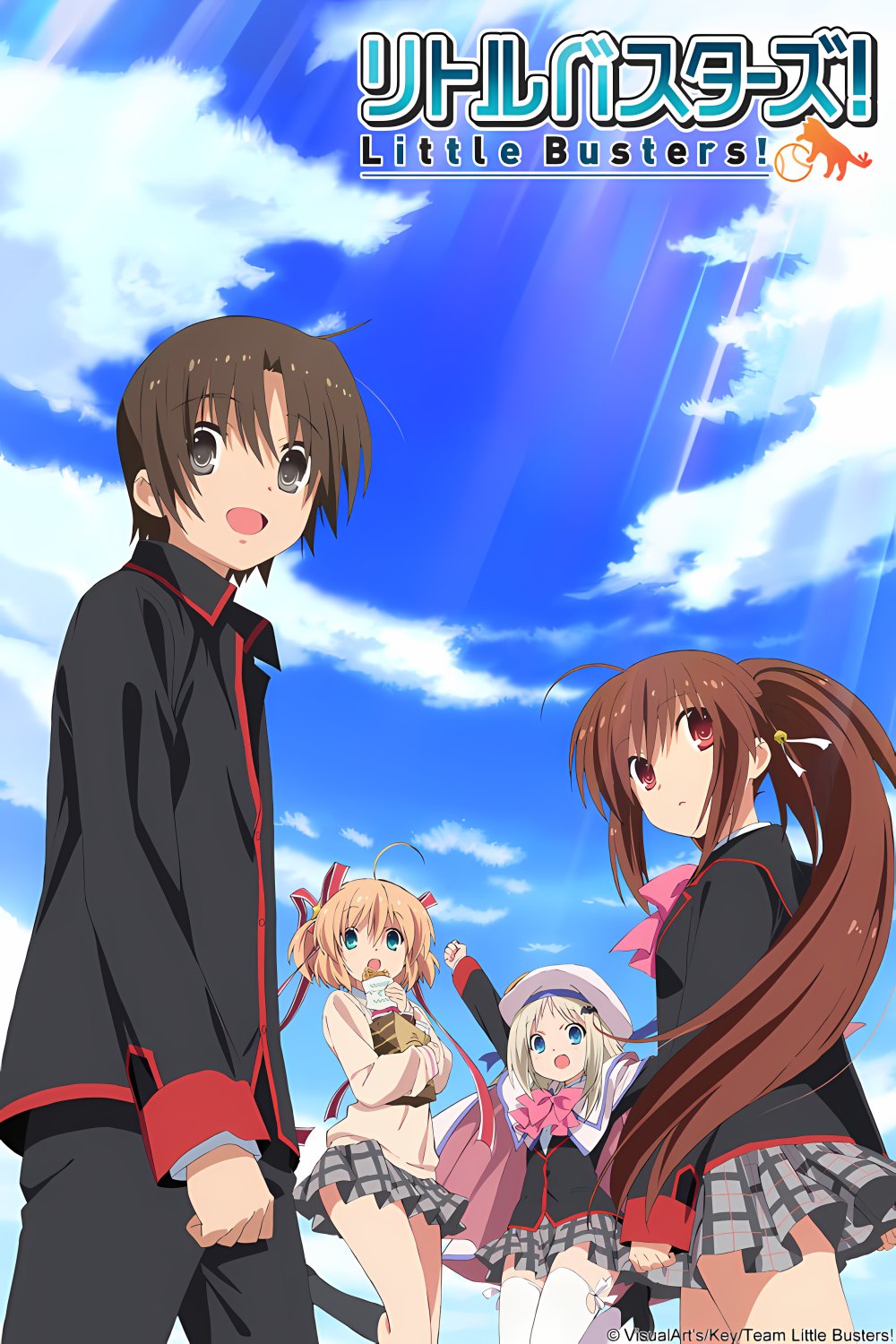
Naoe Riki is a quiet and sensitive high school student suffering from narcolepsy and experiencing trauma after the loss of his parents. At the most difficult moment of his life, Riki was pulled out of despair by four peers: the charismatic Natsume Kyousuke, his shy sister Natsume Rin, the muscle-head Inohara Masato, and the kendo master Miyazawa Kengo. Together, they form a tight-knit group that has become a substitute for a family for Riki.
Kyousuke, as a third-year student approaching graduation, makes the rest realize that their carefree days will soon come to an end. To hold onto these fleeting moments of youth, he comes up with the crazy idea of starting a baseball team and calls it the Little Busters. It is intended to be their way of spending time together before they part ways.
Little Busters! (2013) – Audiovisual Design
Video
The anime adaptation was handled by J.C.Staff, who faced the difficult task of transferring a visual novel to the screen. Visually, Little Busters! looks very good, although it must be clearly noted that this is not the level of refinement fans were accustomed to by earlier Key adaptations from Kyoto Animation. The graphic style remains quite faithful to the original. The backgrounds in the anime are aesthetic and full of colors, capturing the idyllic charm of the school campus and the surrounding nature. As for the animation, it is fluid and correct most of the time, although in less important episodes, some cost-cutting is visible, and the characters are drawn in a slightly more simplified form.
Fortunately, in key emotional moments, the creators did not disappoint. The characters’ facial expressions are vivid, and several more dynamic sequences were executed with due care. Overall, J.C.Staff may not have delivered fireworks, but the warm color palette and solid direction make Little Busters! pleasant to watch. Artistically, the anime reflects the contrast between the two halves of the plot—the first is bright, full of vivid colors and cheerful shots, while the second becomes noticeably darker, with more subdued colors and symbolic frames.


Audio
The sound layer of Little Busters! greatly contributed to the emotional power of the message. The soundtrack, composed by the Key team, perfectly emphasizes the atmosphere of the scenes. The musical themes are a mix of cheerful melodies accompanying daily antics and touching tracks played during dramatic and nostalgic moments. The Little Busters soundtrack is an absolute masterpiece and easily equals other works by Key. It stands out strongly against standard soundtracks of series of this type, and I am grateful that J.C.Staff decided to use the original tracks from the game.
The opening of Little Busters!, performed by Rita, is an energetic track that perfectly sets the mood—hearing it before each episode immediately improved my mood. The ending Alicemagic (also performed by Rita) is still often on my playlists—I even have the single on a CD next to the soundtracks themselves. On the other hand, the ending from Refrain (Kanata Haruka) has a calmer, soothing tone, leaving the viewer with a moment of reflection after each episode. The opening from Refrain—Boys be Smile—also does the job, and I return to it often (I also own it as a CD single). For fans of the original, the music will be familiar and will certainly evoke nostalgia, while for new viewers, it will become an unforgettable accompaniment to the events on screen.
Voice Actors
It is impossible not to mention the voice actors, who did a stellar job breathing life into the characters of Little Busters. The cast is full of experienced seiyuu, perfectly chosen for the characters’ personalities. Horie Yui in the role of Riki perfectly captures his gentleness and self-doubt—her subtle, warm voice perfectly conveys the protagonist’s kind heart. Tamiyasu Tomoe as Rin disarmingly conveys her social awkwardness. Midorikawa Hikaru, voicing Kyousuke, delivers charisma and energy. Masato sounds loud and boisterous, Kengo—calm and firm, Komari—sweet and carefree, Haruka—cheerful but with a hint of rebelliousness, Kud (Wakabayashi Naomi)—adorable, Mio—quiet and melancholic, and Kurugaya—sensual and confident.
The emotions in the seiyuu’s voices particularly shine in the climactic moments—Rin’s cry of despair, Komari’s breaking voice, Kengo’s anger-filled tirades, or Kyousuke’s trembling whisper—it all hit me hard, enriching every scene.
Little Busters! (2013) – Plot and Characters
Introduction
Little Busters! is an adaptation of a visual novel by studio Key, from which I expected a powerful dose of emotion—and that is exactly what I received. As a devoted fan of earlier Key works and visual novels, I sat down for the screening with high hopes. The story of a group of childhood friends who face adversity together provided me with plenty of emotion, laughter, and nostalgia. Although the adaptation itself is not without its stumbles and simplifications, I enjoyed the whole experience and was left with a feeling of deep satisfaction.
A Brief Overview of the Little Busters! Plot
Naoe Riki is a quiet and sensitive high school student suffering from narcolepsy and experiencing trauma after the loss of his parents. At the most difficult moment of his life, Riki was, however, pulled out of despair by four peers: the charismatic Natsume Kyousuke, his shy sister Natsume Rin, the muscle-head Inohara Masato, and the kendo master Miyazawa Kengo. Together, they form a tight-knit group that has become a substitute for a family for Riki.


Kyousuke, as a third-year student approaching graduation, makes the rest realize that their carefree days will soon come to an end. To hold onto these fleeting moments of youth, he comes up with the crazy idea of starting a baseball team and calls it the Little Busters. It is intended to be their way of spending time together before they part ways.
What is the series about
The initial episodes are maintained in a light, even comedic slice-of-life tone. We observe the characters’ daily school life, their training, and their antics. Classic nakige. Under this layer of humor, however, the first signals gradually break through that each of the newly met team members carries some burden in their heart. Riki, acting as a mediator and the good spirit of the group, sequentially extends a helping hand to each female classmate he encounters. Each of them hides their own demons from the past. From the trauma after losing a brother (the cheerful Kamikita Komari), through a painful family conflict (the mischievous Saigusa Haruka), to an identity crisis and loneliness (the quiet Nishizono Mio). With the sensitivity typical of studio Key, the arcs of these heroines are presented very emotionally.
Riki helps them face their pain, reconcile with the past, and move forward, and in return, he gains their friendship and loyalty. Over time, the eccentric Noumi Kudryavka (affectionately called Kud—she, by the way, got an entire spin-off in the form of a separate visual novel), a half-Japanese girl with an inferiority complex, joins the team, as does Kurugaya Yuiko, an older classmate famous for her genius and stoic calm. Each such episode adds another brick to the bonds connecting the Little Busters, while gently signaling that there may be something more behind the daily joys.


Plot Development
An essential structural element of the plot is the mystery running in the background of seemingly ordinary events. Riki and Rin begin to receive mysterious letters attached to the collar of a cat named Lennon. The anonymous messages set them various missions to complete (e.g., cleaning up a neglected school warehouse), promising to reveal the secret of the world as a reward. Although the tasks initially look like innocent pranks, their realization strangely helps Rin gain self-confidence and open up to new people. Over time, the viewer asks themselves—who is behind the letters and what plan is being hatched in the shadow of this idyllic everyday life?
Season One
The first season of the anime focuses on gathering the team and the personal stories of the new characters, culminating in a symbolic baseball game. This seemingly trivial finale—a friendly match between the Little Busters and another school team—actually serves as a beautiful summary of the journey the characters have taken. The adaptation of the first season of Clannad looked similar, for that matter. Rin goes from being a shy outsider to being braver on and off the field, while Kengo abandons his cold attitude and joins his friends with a smile. Riki, in the role of captain, slowly learns to lead others. This part of the story gives the viewer a solid portion of warm feelings—community, friendship, and youthful optimism. However, the real emotional tornado only arrives in the second season.
Season Two
In the second half, the story takes a sharp turn toward serious drama and supernatural elements. The idyllic atmosphere begins to crumble—the presented world shows certain anomalies that are initially difficult to explain. For example, Kurugaya Yuiko experiences the phenomenon of a time loop. This arc leaves the viewer with the first strong sense of loss and a hunch that the world of Little Busters hides a grim truth.
The culmination occurs when the mysterious letters delivered by the cat Lennon give their final command, which comes as a surprise to most. An even greater surprise is the fact that Kyousuke strongly supports this idea, insisting that his sister leave her comfort zone and become more independent. This decision, however, turns out to be catastrophic in its consequences; however, any further sentence would be a huge spoiler, so I will not delve deeper into the plot of the second season. I will only add that the finale of the anime is a true rollercoaster of emotions and a total surprise.
Story Construction
The narrative construction, ranging from light comedy to deep drama with a touch of paranormal plot twists, is the hallmark of studio Key. Little Busters! may initially give the impression of an ordinary school story about a sports club, but the further into the forest you go, the more tropes typical of visual novels appear. The characters’ separate paths intertwine to eventually reveal the bigger picture. Personally, I was very taken by how smoothly the creators managed to transition from a banal joke to matters of life and death without losing the consistency of the story along the way.
The anime did not manage to capture every detail from the source material—at times, you can feel shortcuts and the acceleration of events. But the overarching goal of the story remained clear. Little Busters! is a story about the power of friendship so powerful that it can overcome even destiny. The second half really keeps you on the edge of your seat and delivers unforgettable emotions, which would not have been possible without the slow start that allowed for bonding with the characters.
Characters
The driving force of Little Busters! are the unique characters and the bonds between them. Friendship is the absolutely central motif, while romantic subplots (though present) remain in the background.
Naoe Riki
The main protagonist, Naoe Riki, initially seems physically weak and unsure of himself—he often faints due to narcolepsy and relies on his stronger colleagues. However, it is Riki who constitutes the heart of the entire group. His kindness, empathy, and determination mean that he can reach each of his friends. In the course of the plot, Riki undergoes an impressive transformation. From a boy who needed care, he becomes someone capable of leading others. When the moment of truth comes, Riki can rise to the occasion and carry the burden that once rested on Kyousuke’s shoulders.
Natsume Rin
The only girl in the original Little Busters group, she is initially an introvert who avoids people. Her best friends are cats—it is in their company that she feels at ease. Rin has a sharp tongue and can be clumsy, leading to many humorous scenes. Under this facade, however, hides a sensitive, kind soul who craves acceptance just as much as the others. As more people join the team, Rin gradually opens up. In the final scenes, she is no longer the same character as before, but a person ready to face reality. Her relationship with Riki evolves from a subtle, childhood liking into a first love—innocent, beautiful, and unobtrusive, serving as an additional ray of hope in the plot.
Natsume Kyousuke
The leader of the Little Busters, a character who is almost legendary in the eyes of his peers. Kyousuke is a third-year student with exceptional charisma. Always smiling, full of ideas and energy. It is he who infects others with enthusiasm for baseball; he organizes outings, contests, and activities. At the same time, Kyousuke from the beginning gives the impression of someone who knows more, who hides worries under a mask of carefreeness. And indeed—his role in the second part of the series shows him in a completely different light. It turns out that the always reliable older brother is ready to sacrifice even his own reputation and relationships just to protect his beloved friends. His decisions in Refrain can be controversial, but having learned the whole truth, it is hard to blame him for anything. Kyousuke carried an unimaginable weight on his shoulders.


Inohara Masato
The source of comedy in the series. He obsessively trains his muscles, makes lofty but not-so-clever statements, and regularly gets into squabbles with Kengo. He is that buddy who sometimes irritates you with his antics, but it’s impossible not to like him. Over time, we discover that Masato, despite his straightforward behavior, has a big heart and understands more than he shows. This is especially visible in the second season.
Miyazawa Kengo
He is as bonded with his friends as the others. Initially, he could not show it, hiding behind rules and honor. In Refrain, it is Kengo who most loudly opposes Kyousuke’s methods. His explosion of emotion is surprising, but also extremely telling. The usually composed boy gives vent to his despair in a critical moment because the family that this group has become for him is falling apart before his eyes.
Saigusa Haruka
The embodiment of sweetness and positive thinking. Always laughing, loving sweets, and looking for small happinesses around her that she could bestow upon others. Her theory of the spiral of happiness, which states that by making others happy, we become happy ourselves, beautifully reflects her character. Komari bonds with Riki almost immediately, and her joy for life slowly spreads to the whole group. However, it was Komari’s story that turned out to be one of the most heartbreaking episodes of the series.
Kamikita Komari
At first glance, she presents herself quite differently than Komari. Always late, disheveled, plotting pranks, and having successive confrontations with teachers. Her arch-enemy is the head of the disciplinary committee, Futaki Kanata, who seems to torment Haruka at every step. The truth, however, turns out to be much darker. Haruka and Kanata are linked by something much deeper and darker. Her rebellion and joviality are actually a defense mechanism, a cry for help, and also an attempt to break out of being in the shadows. Haruka’s arc gradually reveals more secrets, serving up truly intense emotions and a handful of shocking plot twists. Despite everything, the central point of this story is forgiveness and understanding.
Noumi Kudryavka
A petite girl with light hair. One-quarter Russian and three-quarters Japanese, but she was raised mainly abroad. She is one of those Key heroines who has her own peculiar catchphrase. Similar to Ayu from Kanon or Tsumugi from Summer Pockets. Kud loves dogs, wears a funny hat with dog ears, and often tries to show off her knowledge of English, although she is surprisingly bad at it. Her character initially plays the role of the group’s mascot (everyone treats her like a younger sister they want to take care of). However, she too has her dramatic background. Kud’s mother is an astronaut, idolized by her daughter and simultaneously a source of complexes. The creators liked this character so much that she got an entire separate visual novel, which I mentioned earlier.
Nishizono Mio
The most mysterious of the heroines. A petite, pale girl, always with her nose in a book and an umbrella protecting her from the sun. She finds secluded places on the school grounds to indulge in reading in silence. Riki, however, reaches out to her with his typical gentleness. Slowly, we get to know Mio’s tragic personality. It turns out that she suffers from dissociative identity disorder with a rather unusual course. In childhood, due to severe loneliness, she invented an imaginary sister named Midori. This invented persona was everything Mio could not be. Over time, the fictional Midori began to live a life of her own in Mio’s imagination. This arc takes on an almost poetic form in the anime and is extremely interesting and touching.
Kurugaya Yuiko
A heroine who initially seems not to fit in with the rest. Older than the others, attractive, brilliant, and incredibly talented. Kurugaya has a sarcastic sense of humor and likes to tease her younger classmates. For some reason, she decides to join the Little Busters group, explaining that she is looking for entertainment in life. Over time, however, we discover that behind Yuiko’s ironic and composed facade lies a void. She confesses to Riki that she has always felt like an outsider, observing the emotions of others from a distance, as if she herself did not know how to feel true joy or sadness.
Summary of the Cast
The entire cast of Little Busters! creates an unforgettable mosaic of personalities. This is one of those series where we bond with absolutely every character—each of them gets a moment to shine and spread their wings. The relationships between these ten (Riki, Rin, Kyousuke, Masato, Kengo + Komari, Haruka, Kud, Mio, Kurugaya) are written with great sensitivity. Shared lunches, nocturnal conversations on the roof, playing by the campfire—all these scenes emanate authentic warmth.
The characters’ laughter easily infects the viewer, and when the tears come, it is hard to hold back your own. The friendship shown in Little Busters is pure, loyal, and selfless. It is clear that this group is truly ready to do anything for one another. Thanks to this, when the plot moves to a higher level of drama, we are with the characters with all our hearts. Their suffering and joy are felt almost personally. It is the characters who make this story stay in your memory for a long time.

Little Busters! (2013) – Evaluation and Summary
The creators of studio Key in Little Busters! have once again proven that they can write stories that are remembered forever. The skillful selection of subplots, character personalities, and the addition of a touch of mysticism is a recipe for success. Unlike most of their other works, however, it focuses mainly on the theme of friendship, not love (although there is no shortage of that either). Little Busters! is a story full of heart and emotion, which first warms the viewer with warm humor, then sweeps them away in a whirlwind of emotions. I liked the story of Riki and his friends very much—it suited my taste perfectly as a fan of Key’s work. I got what I love about scenarios written by Maeda Jun.
Despite certain simplifications resulting from the adaptation (it cannot be denied that the source material was extensive and the anime creators had to take shortcuts in places), I enjoyed the whole experience. Little Busters! definitely belongs to those titles that are emotionally consuming.
The adaptation by studio J.C.Staff may not be as audiovisual refined as the works of Kyoto Animation, but it does not lack soul. Little Busters! is an anime that I would sincerely recommend to all lovers of adventure dramas and Key fans, although it will be particularly appreciated by those who can see a deep parable about friendship and sacrifice between the lines of a simple story about baseball. Added to this are other aspects, such as the absolutely phenomenal soundtrack and the voice acting.
Finalny werdykt
Final evaluation

Which translation do I recommend to watch Little Busters! (2013)?
- Season 1: UTW-Mazui
- Season 2 & Ex: Refrain Subs
Gallery